Open WhatsApp to begin the fifteen-minute conversation
Go to day one of Thehrav
Call Aaroh about Thehrav
Write to Aaroh about Thehrav
A wide Spiti river valley at dusk: a braided river threading the valley floor, layered desert ridges fading into blue haze, a small village and a thread of road on the far slopes.

SPITI & KINNAUR · TWELVE DAYS

ठहरावTHEHRAV

The act of coming to rest.

The route, and the climb inside it

One road in, another road home.

Twelve days from Chandigarh and back, in one circle — up through Narkanda, Sangla and Kalpa into Kinnaur, on to Nako, Tabo and Kaza in the high desert of Spiti, then over Kunzum La and down past Chandratal and Manali. You never take the same road twice.

An illuminated painted map of the twelve-day route through Kinnaur and Spiti, a gold thread linking Chandigarh, Narkanda, Sangla, Kalpa, Nako, Tabo, Dhankar, Kaza, Kunzum La, Chandratal and Manali around a central seated figure, framed by a woven border.

Map border — a real Kinnauri weave, from the valley you travel.

Spiti is a cold desert high in the mountains, near the Tibetan border — old monasteries, small villages where little grows, and a light you don't get lower down. Getting there is half of it: you go up slowly, so the place arrives in its own time.

Three things are held only for you

  1. First light at Keya thousand-year-old monastery on a hill above the river — you're there for the first prayer of the day, before the valley wakes.
  2. A thousand-year-old painting at Taboone of the oldest monasteries in the Himalaya, its walls painted by hand — a conservator sits with you and reads a single painting, an unhurried hour.
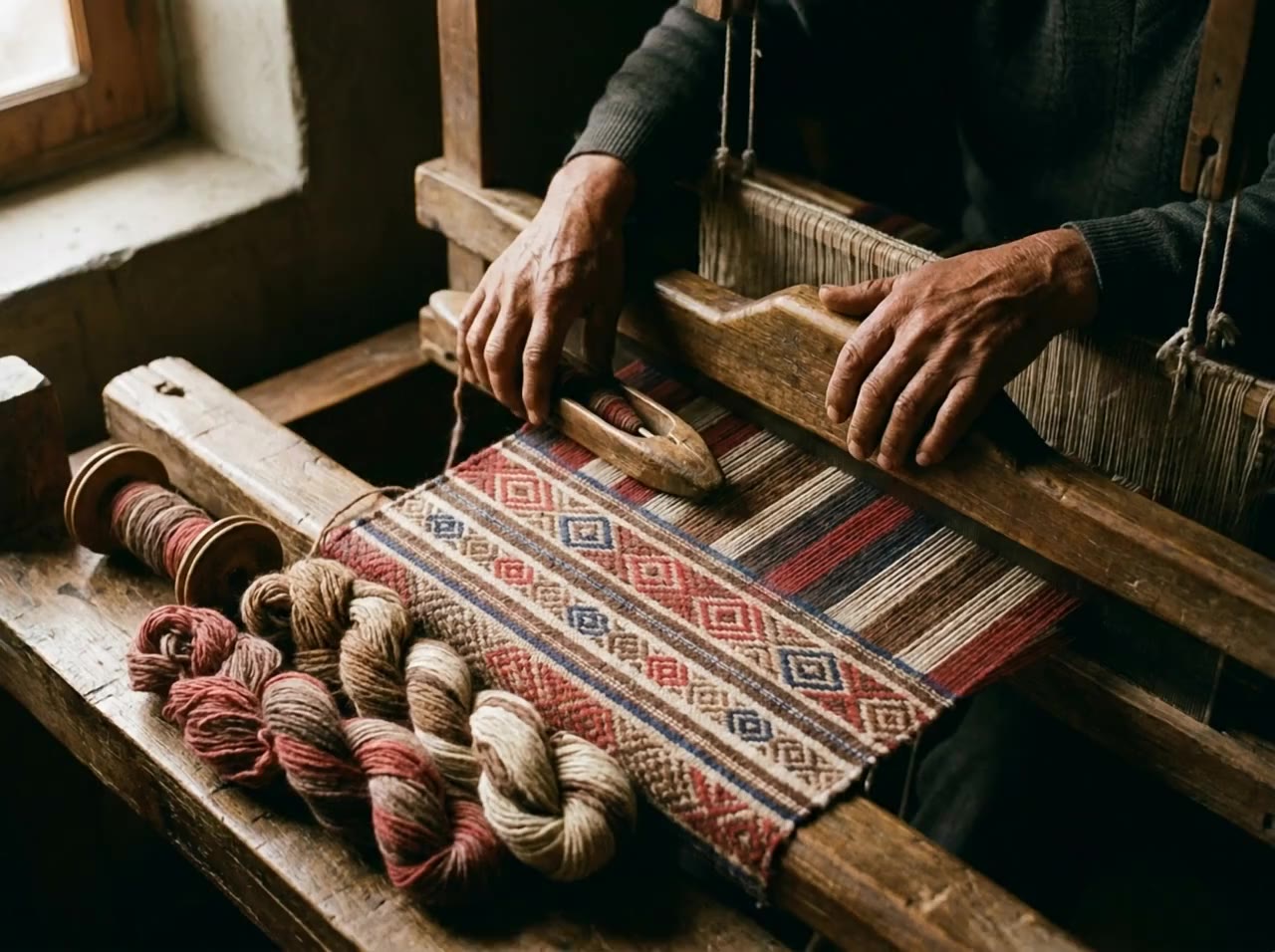
  3. A Kinnauri loom above Sanglain a green valley before the desert begins, a weaver works a hand loom — an afternoon learning to read the weave, thread by thread.

Twelve days · eleven nights · a quiet group of eight, often fewer · one night above four thousand metres

The full twelve days are further down ↓

Most people come back from Spiti with photographs and no memory

The usual journey starts in Manali, crosses Kunzum La on the second morning, and puts you above 4,000 metres before your body has any idea what has happened to it. What follows is well documented — a headache that will not lift, no appetite, no sleep, and a week of standing in front of extraordinary things while feeling too unwell to care about them.

The cost is not really measured in medicine. It is measured in what you miss. Key Monastery at nine in the morning is one of the great sights of the Himalaya. It is worth being awake for.

Thehrav is built the other way round. Twelve days instead of six. You enter Spiti from below, through Kinnaur, gaining height in small deliberate steps. You spend two nights in the Baspa valley before you ever reach Kalpa. Every high village is visited in daylight and slept off lower. And Kunzum La — the pass every other journey crosses on day two — is crossed on day ten, when you are ready for it.

None of this is comfort for its own sake. It is the difference between seeing Spiti and being there for it.

आरोह — Where the name comes from

आरोह — aaroh — is the ascent: the way a raga climbs, note by note, in order, without skipping. We took our name from the climb before we ever built this journey. Thehrav is the one that means it most literally.

You will stand at 4,551 metres on the tenth morning, and you will be well enough to feel it.

Who it suits

Adults, eighteen and over, in ordinary everyday health. No trekking, nothing technical — the longest walk is a gentle one on uneven ground. But two kilometres at these heights is not two kilometres at home: there is roughly a third less oxygen, and everything costs a little more than it looks like it should. If you can walk comfortably for half an hour at home and manage a few flights of stairs without stopping, this is well within you. We ask everyone to walk thirty minutes a day in the weeks before departure — it changes the journey more than any piece of gear.

What it is not

Not a road journey with a monastery attached. Not a trek — you will not carry anything or sleep on the ground. Not a photography workshop, although you will come home with better photographs than usual because you will be awake. And not a way to see Spiti in six days. If six days is what you have, we would rather you travelled with somebody else than travelled badly with us.

When it runs

This runs in autumn. In winter, Kunzum La closes and Spiti is reached another way entirely. That is a different journey.

Begin the conversation

Four rules, and we do not break them for anybody

This is the part of the journey you will never see on the road, and the only reason the rest of it works.

  1. You never sleep much more than 700 metres higher than the night before. The single largest step on the whole journey is 703 metres, into Nako on day five — which is why we take that day gently and arrive early, with nothing else asked of you.

  2. Every high place is visited by day and slept off lower. Kibber at 4,270 m and Komic at 4,587 m are day visits. On both nights you come back down to Kaza at 3,650 m.

  3. One full day without changing base, before the height, not after. Day three at Sangla — a valley full of things to do rather than an empty one, but you sleep in the same bed you woke in. It is the day that makes the rest of the journey possible. Chitkul, visited by day from Sangla, rises to about 3,450 metres — a first taste of real height before Nako. Climb high, sleep low.

  4. The pass is crossed at the end. Kunzum La on day ten, not day two. Night ten is the only night above 4,000 metres on the entire journey, and it comes after nine days of preparation.

What we carry, and what we watch

Oxygen cylinders travel in every vehicle, every day, from day five onward. A full altitude medical kit including acetazolamide and dexamethasone rides with your host. A pulse oximeter is read for every guest, every evening, and the numbers are written down.

If anyone is unwell we lose height first, always, and the journey is built with the room to do it. For a serious case the whole plan reorganises around getting that person down safely — we do not send anyone down the mountain alone, and we do not pretend the schedule matters more than a person. For milder cases a short drop to a lower point and a rejoin is usually enough. From Kaza we can reach Tabo, 370 metres lower, in about two hours, and Reckong Peo, 1,360 metres lower, in about seven. That plan exists before the journey starts, not during it. Altitude affects everybody differently, and no route can promise nobody will feel it — but nothing here is worth pushing through.

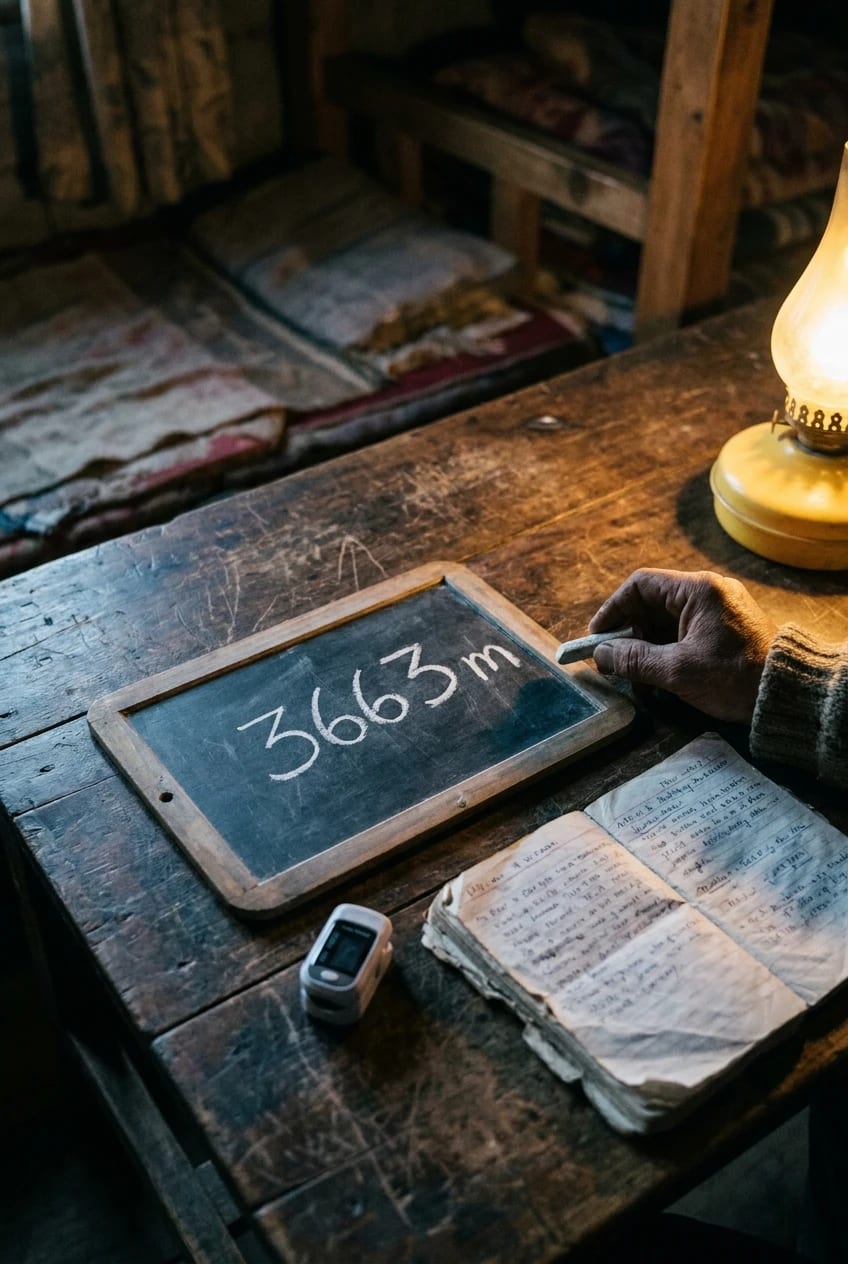
The Marking

Before dinner your host chalks tomorrow’s sleeping height on a slate for everyone to see. Then your host takes each person’s oximeter reading and a quiet word about how they are feeling — privately, written down, never read out. What the group hears is only the decision: we go on, we wait, we rest, or we drop. Altitude is not a competition, and a good number is not the same as a good morning.

A hand chalking tomorrow’s sleeping height — 3663 m — on a slate by lamplight, a pulse oximeter and the host’s worn notebook beside it.

The three questions everybody asks —

Never been high before

Most of our guests have not been this high. Having done well at altitude before is the best sign there is; its absence tells us little. What decides is how slowly you go up, and that is the one thing we control completely. Tell us your history on the call and we watch accordingly.

Should I take acetazolamide

That is a conversation with your own doctor, not with us. Plenty of guests take it and plenty do not. Building the route this way keeps it your choice. If you are prescribed it, bring it, and tell your host on the first evening.

If I have to come down

Then we lose height, and it is handled properly. Nobody goes down the mountain alone — the plan reorganises around getting you safely lower rather than leaving you to a driver. You are not charged for the nights you miss. Nobody has to be brave about this, and nobody has ever had to apologise for it.

Begin the conversation

The climb in

Five days to reach the first night at 3,663 metres. Few take this long, and that is the point.

Day 1Arrive low

Chandigarh → Narkanda

We collect you in Chandigarh in the morning and drive up through Solan and past Shimla into cedar forest. Narkanda by late afternoon. Before dinner there is a short walk in the deodar above the town — twenty minutes, no climbing — and then the first Marking: your host writes tomorrow’s sleeping height on the slate, takes everybody’s first oximeter reading, and explains what the next eleven nights are going to ask of you. Then an early dinner. Nothing else is planned. Arriving is enough for one day.

≈2,700 mNarkandanight 1≈170 km5–6 h

A Kinnauri apple orchard at harvest: gnarled trees heavy with red apples and wooden crates on the grass, a stone-and-timber village on the forested slope beyond, snow peaks above.
KINNAUR, THE LAST GREEN BEFORE THE DESERT

Day 2Into the Baspa

Narkanda → Sangla

The longest drive on the climb in, treated honestly — one road, one proper sit-down lunch, no detours dressed up as sightseeing. We drop to the Sutlej at Karcham and turn up the Baspa, one of the valley’s prettiest turns, climbing through pine and apple orchard to Sangla by evening. Wooden houses, a river you can hear from the room, and Kinner Kailash — the sacred peak — from an angle Kalpa never shows you. The Marking, then dinner.

≈2,700 mSanglanight 2≈200 km7–8 h

Weathered hands working a patterned shawl on a wooden pit-loom, dyed skeins resting in the window light.
THE LOOM AT RAKCHAM · SANGLA VALLEY

Day 3The last village of the Baspa

Sangla — Chitkul · Rakcham · Kamru

Sangla — a full day in the Baspa Valley. We leave early for Chitkul — the last village of the Baspa Valley, close to the Indo-Tibetan border — reached via Rakcham, wooden houses along the river, the Kinner Kailash range from the other side. Back to Rakcham for the Loom afternoon at the master weaver’s household. Late afternoon at Kamru, where the man who keeps the keys walks you through the five-storey wood-and-stone fort that once served as the seat of Kinnaur’s rulers. Rest, dinner, sleep.

≈2,700 mSanglanight 3The Loom at RakchamChitkul ≈3,450 m

Day 4Down to the Sutlej, and up again

Sangla → Kalpa

A short drive of about two hours, arriving Kalpa by lunch. The afternoon is at Kalpa: if the apple harvest is running we walk to the orchard we have picked with for years — four generations on the same terraces — in the golden light for the grading table, an hour or two at the crates. Otherwise the afternoon is genuinely free — a shawl weaver’s loom, the walk to Roghi, or sleeping. At last light a neighbour who is argumentative about geology walks you to the edge of the village and tells you what Kinnauris see in the rock face of Kinner Kailash. The Marking, then dinner.

≈2,960 mKalpanight 4≈50 km≈2 h

Day 5Into the high desert

Kalpa → Nako

We take this day slowly, because it carries the biggest single step up in sleeping height on the whole journey. Somewhere on the climb to Nako the green gives out, and does not come back. Nako is a village of mud-brick houses, willows and a small lake, and we arrive while there is still plenty of light. A slow circuit of the lake if you feel well, the old wooden temple if it is open, and an early dinner. The rooms here are the simplest of the eleven nights — we say so plainly, and our care rises to meet them.

3,663 mNakonight 5≈120 km5–6 h+703 m largest step

An old monastery mural of a seated Buddha, its plaster cracked and warmed by candlelight below.
TABO — ONE PAINTING, THE BETTER PART OF AN HOUR

Day 6A thousand years, twice over

Nako → Tabo

A short drive, and we leave the rest of the day for one place. We reach Tabo before lunch, and the afternoon belongs to two things. First, the mural hour: the conservator at Tabo takes the group inside and spends the better part of an hour on a single painting. You leave knowing one thing properly rather than having photographed forty things badly. Then, before dinner, we walk up to the caves in the cliff behind the monastery — meditation cells cut into the rock a thousand years ago by the monks who built Tabo, some still used for winter retreats. A short climb, a quiet hour, an entirely different way of understanding what a monastery is. Tonight you sleep 383 metres lower than last night — that is not an accident, and it is how your body grows stronger for Kaza.

≈3,280 mTabonight 6≈70 km≈2.5 h−383 m, on purpose

Three nights in one base

From Kaza the high villages are day loops.

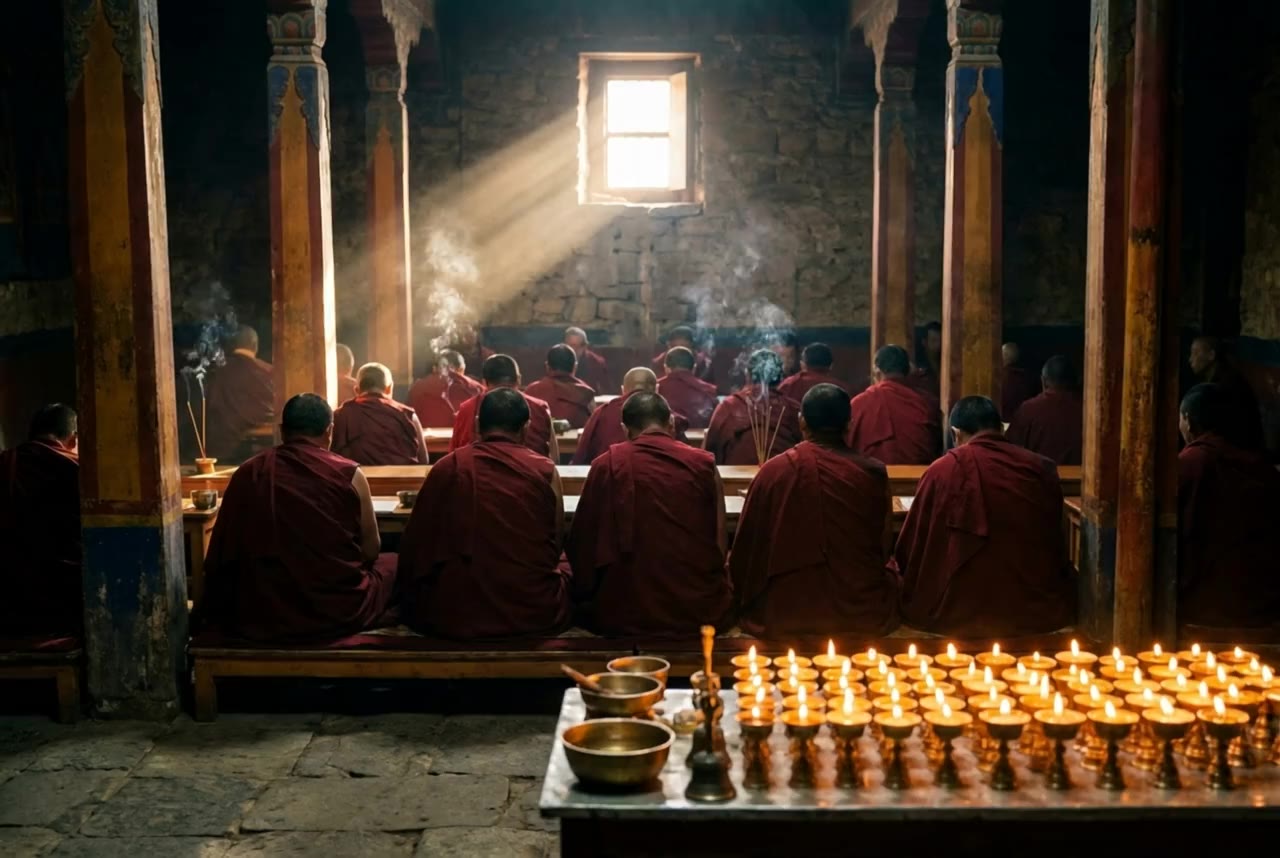
Rows of monks seated from behind at dawn prayer inside Key monastery, a broad shaft of window light falling across the hall and butter lamps burning in the foreground.
FIRST LIGHT AT KEY — THE DAWN PRAYER

Day 7The old capital

Tabo → Dhankar → Kaza

Dhankar on the way: a monastery on a cliff above the meeting of the Spiti and the Pin, and once the seat of this valley’s rulers. One story, told properly, rather than a march through every room. Kaza by mid-afternoon, and then you unpack once. There is no repacking for three days. The daily bag-in, bag-out that quietly exhausts people on faster journeys simply does not happen here.

≈3,650 mKazanight 7≈65 km4–5 h

Day 8Key, and a kitchen at Kibber

a morning loop from Kaza

Key first, and early — before the day’s vehicles reach the hill. A thousand years old and home to a few hundred monks, Key is a working monastery, not a monument, and we come to it that way. When the monastery invites us we sit quietly at the dawn prayer, in the place they choose, and afterwards are usually offered butter tea in the kitchen that has fed this community through a thousand winters. If the monk who receives us has time, we sit with him a while — not a teaching, a conversation about winter, silence, and what the monastery needs. We are there as guests of the monastery, at their invitation. Then Kibber, where a household’s field needs whatever it needs that week and you lend a hand, before a meal on the kitchen floor — eight people is already a lot for that room.

≈3,650 mKazanight 8≈40 km3–4 hDay high 4,270 m

Day 9The vanished sea

Langza · Komic · Hikkim

Langza first, under its great seated Buddha, where a local from Langza who reads the Tethys seabed takes the group onto the slope and teaches you to find and read the fossils — ammonites from the Tethys, an ocean that closed when India met Asia. Every one of them stays exactly where it lies. Then Komic at 4,587 metres, the highest point of the journey, and Hikkim, where you can post a card if you feel like it. When your departure falls near a new moon, we come back up to Langza after dinner with a telescope, and you go home with a long-exposure portrait taken beneath it.

≈3,650 mKazanight 9≈45 km4–5 hDay high 4,587 m

A weathered hand rests beside an ammonite still set in the rock where it lies, high on the slope at Langza.
THE TETHYS, UNDERFOOT AT LANGZA — FOUND, READ, AND LEFT WHERE IT LIES
Prayer flags strung across Kunzum La, bare peaks and a wide cold sky beyond the pass.

The crossing, and the way down

Now the road turns for the pass — the last climb, and the far side.


Day 10Over Kunzum

Kaza → Kunzum La → Chandratal

The last climb, and the first night above 4,000 metres. In the morning we check on everybody, and on the road, and we cross only when both are ready. Kunzum La is wrapped in prayer flags and wind, and from the top you get a long look back down the whole valley you have spent a week inside. Then we drop to the camps near Chandratal. The lake shore is protected, so the camps sit back from the water; we drive most of the way in and you walk the final stretch to the lake if you wish — a gentle half hour or so over stony ground, and easy to sit out. Tents with proper beds, thick bedding, a hot dinner. The coldest night of the journey, and by now a manageable one, after nine days of preparation.

≈4,300 mChandratalnight 10≈95 km5–7 hPass 4,551 m

Camp tents below the night sky near Chandratal, one window glowing warm against the dark ridge and the Milky Way.
CHANDRATAL · NIGHT 10 · ≈4,300 METRES

Day 11Down into green

Chandratal → Atal Tunnel → Manali

The wildest road of the journey, and we give it the entire day. Stream crossings, bare valleys, the long descent past Batal and Gramphu — and then the Atal Tunnel, which you enter surrounded by brown desert and leave in pine forest. Ten minutes, two different worlds. Manali by evening: a hot shower, a proper bed and a long dinner that nobody has to leave early.

≈2,050 mManalinight 11≈115 km6–9 h

Day 12Home by the other road

Manali → Chandigarh

A slow breakfast, and then the drive home — Manali to Chandigarh by road, one long day with proper stops, arriving Chandigarh by early evening. We never put a flight at the end of a mountain road — which is exactly why last night was spent in Manali, and not somewhere higher.

≈350 mChandigarharrival≈310 km8–9 h

The one thing the mountain decides

Late in the season the Chandratal camps may already have closed; then night ten is spent at Losar and we cross Kunzum the next day. And if Kunzum itself is closed by snow, the journey turns and exits the way it came, through Kinnaur, and the final nights change. The one-way route is our intention, not a promise we make against the mountain. We tell you as soon as the season decides, and we would rather change the itinerary than the truth.

The whole climb, in one line

Where you sleep, against where you go — night · metres above sea level.

4,000 M — CROSSED ON ONE NIGHT ONLY+703 M−383 MKOMIC 4,587 MKUNZUM LA 4,551 MTHE ONLY NIGHTABOVE 4,000 M123456789101112
The route in words
Thehrav route, sleeping heights and day highs
DayWhere you sleepNightSleeping heightHighest point that day
1Narkandanight 1≈2,700 m
2Sanglanight 2≈2,700 m
3Sanglanight 3≈2,700 mChitkul · Rakcham ≈3,450 m
4Kalpanight 4≈2,960 m
5Nakonight 53,663 m
6Tabonight 6≈3,280 m
7Kazanight 7≈3,650 mDhankar 3,894 m
8Kazanight 8≈3,650 mKey · Kibber 4,270 m
9Kazanight 9≈3,650 mLangza · Komic · Hikkim 4,587 m
10Chandratalnight 10≈4,300 mKunzum La 4,551 m
11Manalinight 11≈2,050 m
12Chandigarharrival≈350 m

Three, and never more

Each attaches to a place already on the road and adds not one kilometre of driving. Each rests on a relationship, not a booking — the part that cannot be copied.

Rows of monks seated from behind at dawn prayer inside Key monastery, a broad shaft of window light falling across the hall and butter lamps burning in the foreground.

I

First light at Key

Key Monastery, above the Kaza base. We are invited, never booked.

“We sat at the back of the dawn prayer while it was still dark, and afterwards a monk poured us butter tea in a kitchen that has fed that monastery for centuries. I have never been anywhere like it.”

Ananya R., Delhi · Spiti, September 2025
An old monastery mural of a seated Buddha, its plaster cracked and warmed by candlelight below.

II

One painting, one hour

The conservator at Tabo, trained in thangka restoration at Dharamshala.

“The conservator spent forty minutes on one painting. I can still walk you through it, figure by figure.”

Arjun T., Mumbai · Spiti, September 2025
Weathered hands working a patterned shawl on a wooden pit-loom, dyed skeins resting in the window light.

III

The Loom at Rakcham

A master weaver’s household — six generations at the same pit-loom.

“I sat with her for an hour and understood a pattern I’ve walked past in shops my whole life. It changes how you look at cloth.”

Priya M., Bengaluru · Spiti, September 2025

One person is with you for all twelve days

Not a rotating roster, not a driver with a clipboard. The same face at the first Marking in Narkanda and on the pass on day ten.

An older man in a wool sweater and scarf stands before his village and the river valley, mountains behind.

your host for the twelve days

Aaroh host on Thehrav · Rangrik, Spiti

Your host was born in Rangrik, twenty minutes from Kaza, and has worked this road for eighteen years — long enough to have watched the Atal Tunnel change what the valley means in winter. They hold a current Wilderness First Responder certification, carry the oxygen and the medical kit, and run the Marking every evening.

Your host is also the reason the doors on this journey open. The people whose day you join are not vendors we booked; they are people your host has known for years, and in several cases people who first said no.

And the people whose day you join:

the master weaver at Rakcham · the orchard family at Kalpa we have picked with for years · a household in Kibber, where you eat on the kitchen floor · the keeper of the keys to Kamru fort · the conservator at Tabo · a local from Langza who reads the fossils.

These are the people we work with, named as they stand today. Mountains being what they are, someone is occasionally away when you travel — a harvest that runs late, a family matter, a season that turns early. If that happens, you will know before you leave. We will not put someone else in their place and call it the same thing.

Adults share a floor meal around low tables in a warm stone kitchen at Kibber, a stove and window behind them.
A KITCHEN FLOOR IN KIBBER — 4,270 METRES

Comfort, stated rather than promised

Every night but Chandratal has an attached bathroom and hot water. Rooms are twin-share. If you would like a room to yourself — or your group is an odd number and someone would rather not share — a single room can be arranged for a single-occupancy supplement.

  • 1Narkanda≈2,700 mDeodar at the window. The first night out of the plains.
  • 2–3Sangla≈2,700 mThe Baspa audible from the bed. Two nights, so one morning you do not pack.
  • 4Kalpa≈2,960 mKinner Kailash across the valley, changing colour before breakfast.
  • 5Nako3,663 mThe highest you will have slept so far. Extra bedding, and the green gone from the land.
  • 6Tabo≈3,280 mA short walk from a monastery that has stood a thousand years. Tonight you sleep lower than last night, deliberately.
  • 7–9Kaza≈3,650 mHeated, hot water that holds, and the relief of unpacking once.
  • 10Chandratal≈4,300 mCanvas, not walls. A real bed, four blankets, a hot water bottle each. Washing tents are shared, and there is no power once the generator stops. The only night above four thousand metres.
  • 11Manali≈2,050 mThick air again, and a shower nobody rushes.

Properties are confirmed to you by name in the booking pack, four weeks before departure.

The food

Vegetarian for all twelve days, without exception and without apology. Spitian and Kinnauri home cooking wherever we are hosted; simple Indian and continental elsewhere. A proper sit-down lunch every driving day. Jain and vegan can usually be arranged with two weeks’ notice; where fresh preparation isn’t possible high in the valley, we carry packaged Jain and vegan options, so you are never without a proper meal. Drinking water is filtered and provided — no bottles are bought on this journey.

In the vehicles

Two Innova Crysta or equivalent, never more than four guests to a vehicle. Oxygen in both from day five. Blankets, a hot flask and a first-aid kit in each. Seats rotate daily so nobody spends a week in the middle row, and we stop whenever anybody asks — including for no particular reason.

Set by the season, not the calendar

Autumn only. The season is set by the harvest at one end and by Kunzum at the other, and neither of them negotiates.

A small number of departures each year, never more than eight. Dates and the price for 2027 are set with our ground team once the season shows its hand — the harvest, the first snow and the state of the pass decide more than we do. Both are announced together, and anyone who has written to us hears first.

When in the autumn you travel shapes the journey. The earliest departures move with the apple harvest, and when they fall near a new moon the skies over Langza are as dark as anywhere on earth. The later ones catch the valley turning gold, and woodsmoke rising as Spiti readies for winter, the crossing left to the mountain. One journey, worn differently depending on the week.

Tell us roughly when you can travel, and we will hold a place while the season’s dates firm up.

Included

  • Eleven nights as listed
  • All meals, all twelve days
  • Two vehicles and drivers throughout
  • Your host, for the full journey
  • All three signatures
  • Protected-area permits where required
  • Oxygen and the medical kit
  • Monastery and household contributions
  • Filtered drinking water.

Not included

  • Travel to Chandigarh
  • Optional pickup and transfer from Delhi, arranged on request — the journey itself begins and ends in Chandigarh
  • Optional Bhuntar transfer and onward travel from either endpoint
  • Travel and medical insurance, which we require
  • Anything personal
  • Tips, which are never expected.

The conversation

Every Thehrav begins with a conversation, not a form.

The honest answer to “is this right for me” cannot be written on a page — it depends on your health, your history at height, and who you are travelling with. So we talk first, for fifteen minutes, before anybody pays anything. If we think a different journey suits you better, we will say so.

Begin the conversation

+91 97270 27061enquiry@aarohescapes.com

A deep night sky over a dark ridge, the Milky Way standing above the mountains and a faint warm glow along the horizon.

ठहरावTHEHRAV

Twelve days is how long it takes to arrive properly.

Chandigarh → Spiti → Chandigarh. Never more than eight. A few small-group departures each autumn, dates set with our ground team by season. Then the pass closes for winter, and the valley gets on with its own life.

Begin the conversation

+91 97270 27061 · enquiry@aarohescapes.com · www.aarohescapes.com